
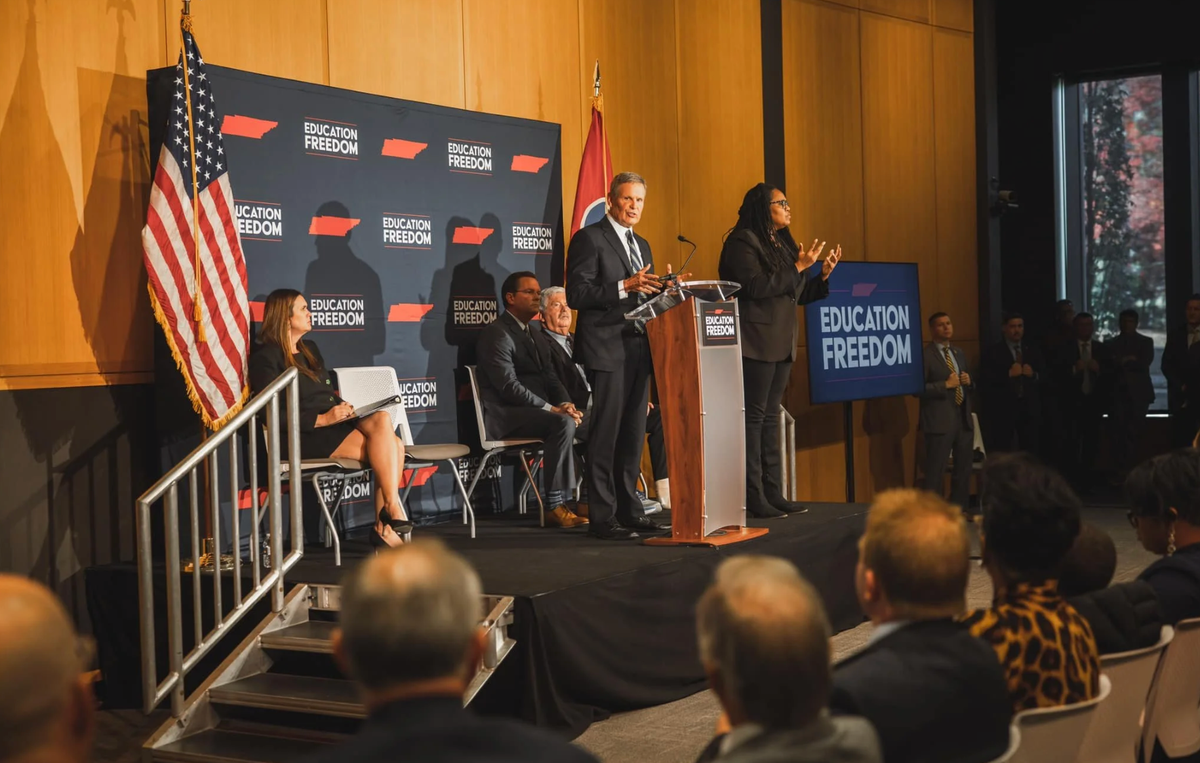

Governor Bill Lee’s proposed expansion to the Education Freedom Scholarship program cleared a key hurdle during Monday’s House floor session.
House Bill 2523, which is sponsored by Rep. William Lamberth, R-Portland, was passed on the floor with a 52-43 vote after an hour and a half of discussion. The bill’s Senate counterpart will be heard on the floor on Wednesday.
What the Bill Does
Lawmakers passed the Education Freedom Scholarship program, frequently referred to as vouchers, last year to allow up to 20,000 families the ability to use tax dollars for private school expenses.
The House’s version of the legislation increases the number of available scholarships by 15,000. It also allows schools to receive “hold harmless” funding for students with a Social Security number who leave the district. Beginning in the 2028-2029 school year, that funding will only apply to students leaving as a direct result of the Education Freedom Scholarship program.
The bill also requires the Department of Education to collect and report whether Education Freedom Scholarship recipients attended public schools.
Funding and Access Debated
The program has been opposed from the beginning by Democratic lawmakers who argue that it diverts needed funding from public schools.
Representative Jason Powell, D-Nashville, continued to make that argument on Monday.
“The number one thing I continue to hear, as a parent and also as a representative, is how our schools continue to be plagued by underfunding and (lack of) resources,” Powell said. “Meanwhile, we have expanded this program with no real checks. We're not holding anyone accountable. We are not going back and auditing and looking at who is receiving these vouchers, because we know the answer.”
Lamberth addressed those concerns by pointing out that the General Assembly has provided more than a billion additional dollars to schools in recent years.
“We will continue to put additional funds into K-12 public schools,” Lamberth said. “That's where over 950,000 of our children are going to school today. There (are) 20,000 scholarships. This bill, as amended, would add 10,000 more, and there (are) 5,000 that will be added in the budget. That's a total of 35,000 kids that could get a scholarship, and not one red cent comes from a public school. No school will lose any money based on this particular program.”
Representative Bo Mitchell, D-Nashville, made a different case against the bill by pointing out that not all students have access to a private school, even with the funding.
“We've got 20 counties in this state that don't even have a private school,” Mitchell said. “So (those) counties aren't even getting it. There (are) another additional 20 counties that aren't participating in this scam. So, we’ve got nine counties (where) there's not one child in this scam.”
Supporters have pushed back against that criticism, arguing that the expansion is needed because the state has received more applications than scholarship slots have been available for two consecutive years. Bill co-sponsor Representative Scott Cepicky, R-Celleoka, defended the proposed expansion as another step in the state’s education improvement.
“We're here to create opportunity for the students of Tennessee,” Cepicky said. “We're here to give them a better opportunity of success that their parents feel that they need. Over the last eight years since I've been in the General Assembly, we've taken public education from 47th in the country to now in the low 20s… We have now have school choice that allows parents to choose the best option for their students.”
Differences in the Senate
The Senate version of the bill (Senate Bill 2247) increases the available scholarships by 20,000.
It remains to be seen whether the Senate will concur with the House version or move forward with any new provisions. A similar disagreement in 2024 led Governor Lee to shelve legislation to create the program for that year.