Education Savings Account Participants Grow Math Proficiency by More than 70 Percent in the Program’s First Three Years

Stock image of a classroom (Photo by the Tennessee Comptroller)
A detailed analysis by the Tennessee Comptroller of the Education Savings Account (ESA) found that participating students have made improvements in English language arts (ELA) and math proficiency during the program’s first three years.
Just 11 percent of participating students tested proficient in math on state testing during the program’s initial 2022-23 year. That number rose to 19.5 percent in the 2024-25 school year.
ELA proficiency also rose from 23 percent in 22-23 to 26.3 percent last school year.
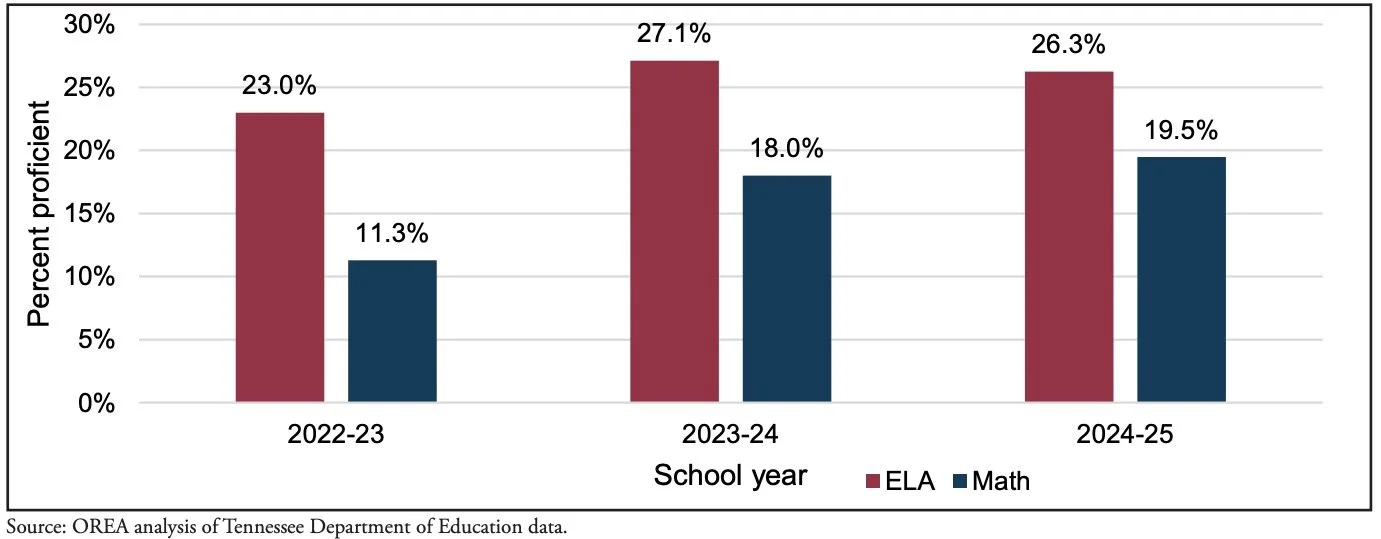
Graphic by the Tennessee Comptroller
Program History
Lawmakers approved the ESA program in 2019 to allow families in Nashville and Memphis to use taxpayer dollars for private school expenses. Legal challenges delayed its launch until the 2022-23 school year, and Hamilton County families gained access to it the following year.
The program differs from the Education Freedom Scholarship program that went into effect statewide this year in that applicants must meet income requirements. A family of four, for example, couldn’t exceed an annual household income of $81,120.
The ESA also provides families with more money for private school expenses. This year, ESA recipients received awards ranging from $9,747 to $9,787, depending on their school district, compared to the $7,295 that students received from the Education Freedom Scholarship. Both programs are frequently called “school vouchers” by opponents.
A total of 3,693 students took part in the ESA program during the 2024-25 school year, up from 2,088 the prior year and 452 in 2022-23. The Comptroller’s analysis found that more than 80 percent of participants reapplied each year, including 84 percent who participated in the 2023-24 school year.
Opportunities for Improvements
The Comptroller provided six recommendations to improve the ESA program, including aligning it with admission calendars for non-public schools. Many private schools begin their admissions process in the fall, up to four months before the ESA application is available online.
The Comptroller believes this “misalignment” could be playing a role in why more than 20 percent of students who have been approved for the ESA didn’t use it. That includes more than 1,200 students who qualified for an award during the 2024-25 school year.
“Some schools may require only an application (similar to public school enrollment) while others require multiple steps, including a school tour, a student visit during the school day, one or more interviews, a placement/aptitude test, and other requirements. Families who are unfamiliar with the process to enroll in a non-public school may be surprised by the length of time it takes between initial interest and final contract signing,” stated the report. “To reduce the number of approved students who do not participate in the ESA program, TDOE (Tennessee Department of Education) should consider opening the student application when most non-participating schools begin their admissions processes and adjust ESA application documentation accordingly.”
Relatedly, the Comptroller recommended using television, radio, and social media to ensure that economically disadvantaged families are aware that they can apply for the program.
Most ESA participants come from households with an average income below $80,000, according to the Comptroller’s research. The average household income among participants in Nashville was $76,670, followed by $73,949 in Chattanooga and $61,353 in Memphis.
Improving Academic Measurements
The Comptroller also recommended that the state consider using additional testing data and performance metrics to measure the program's success.
While ESA participants in Memphis recorded higher ELA and math proficiency rates on the Tennessee Comprehensive Assessment Program (TCAP) than their peers in Memphis-Shelby County Schools over the last two years, the same was not true for participants in Nashville and Chattanooga.
The Comptroller argues that the state will get a clearer picture of how well private schools are serving ESA participants if achievement data beyond the Tennessee Comprehensive Assessment Program (TCAP) are used.
“TDOE’s current academic achievement data is limited to the TCAP test, however, which is based on standards that may or may not align with ESA schools’ curriculum. By comparison, the state’s accountability protocol for public schools includes a number of additional metrics: ACT/SAT scores, early postsecondary test results, absenteeism, and industry credentials, to name a few. Collecting additional data on ESA students would provide a fuller picture of their performance and allow for broader comparisons with their peers,” stated the report.