

House Subcommittee Advances Bill Requiring Data Collection on Immigrant Students
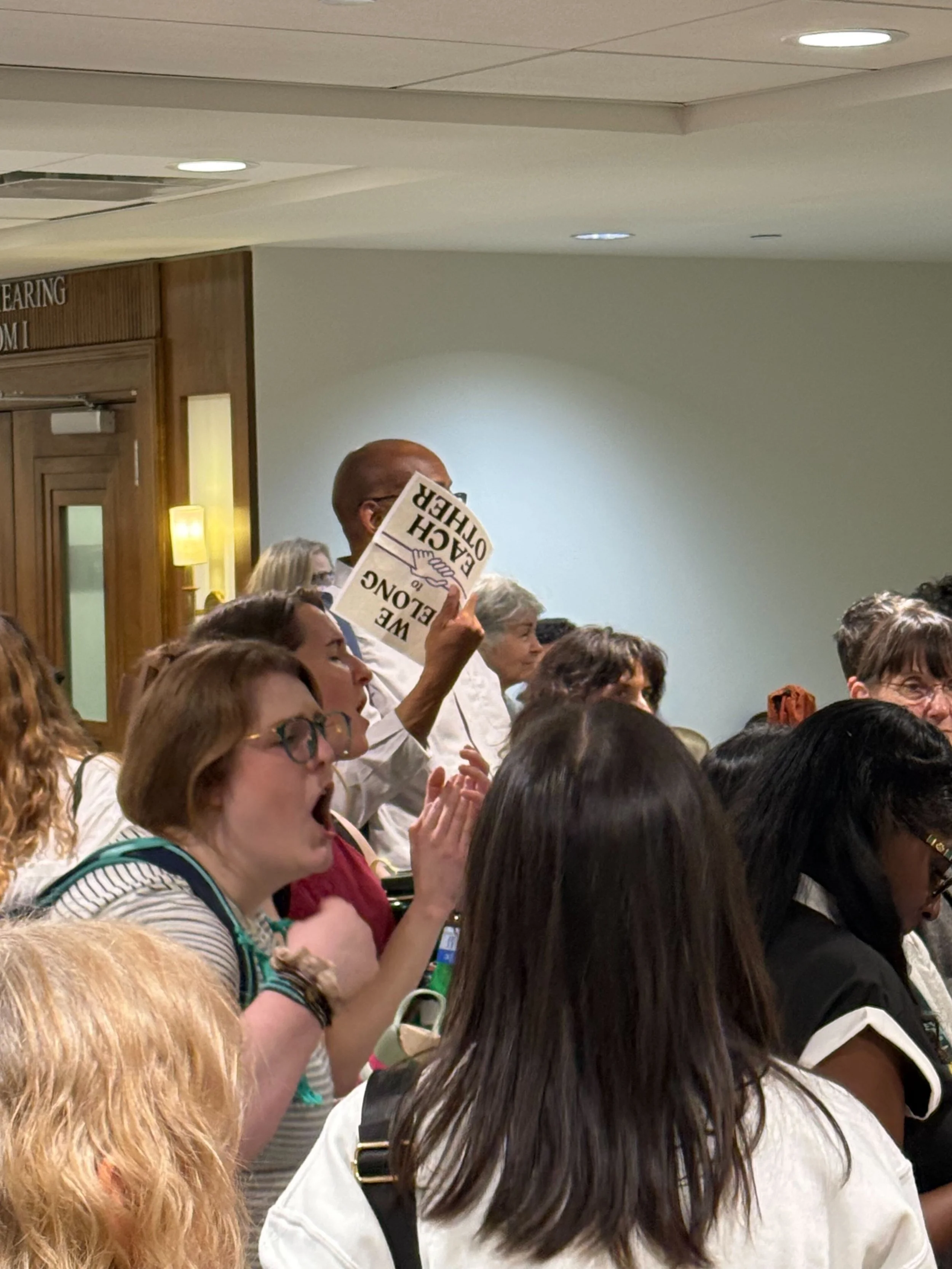
Opponents of legislation targeting immigrants rally in the Cordell Hull Building on Wednesday (Photo by Ben Schmisseur)
A revised version of a bill that would have initially allowed school districts the ability to charge students lacking permanent legal status tuition advanced from the House Finance, Ways, and Means Subcommittee on Wednesday despite vocal protests.
House Bill 0793 attracted considerable attention last year before its sponsor, Representative William Lamberth, R-Portland, put it on hold for the year because of funding concerns.
Amended Version
Lamberth amended the legislation this year to only require districts to provide the state with data on these immigrant students to assess their financial impact.
During Wednesday’s subcommittee meeting, Lamberth said he’s been in contact with the Trump administration for nearly 10 months but hasn't received a clear answer on whether the bill, in its original form, would put $1.1 billion in federal education funding that Tennessee receives at risk.
“I understand in some part why they would be unwilling to answer a question on a bill that has not passed yet,” Lamberth said. “But again, a data bill does not endanger those funds, which is what this bill is now.”
Representative Gary Hicks, R-Rogersville, inquired about what data would be included in a report under the bill if it were to go into effect. Lamberth assured him that no names, addresses, or other personally identifiable information would be shared with the Department of Education, but it would receive information regarding the number of students who are enrolled in a school district who:
· Can produce documentation verifying they are a United States citizen.
· Are in the process of obtaining citizenship.
· Are of legal immigration or Visa status.
· Are subject to pending immigration proceedings in which a final removal has been issued.
· Refuse to provide or produce documentation establishing they meet any of the above criteria.
Representative Johnny Shaw, D-Bolivar, asked a question brought up by many of the bill’s opponents: Would this information be used to separate the children of undocumented immigrants from their families?
“None of this bill would affect any of that whatsoever,” Lamberth said. “Whatever processes that the federal government utilizes now would be utilized under this.”
Opposition Testimony
A handful of opponents showed up to testify officially against the bill, including Nashville immigration attorney Johnny Epstein, who said it would not gather useful data for the state.
“Immigration status does not neatly divide into lawful versus unlawful, or as the bill describes, ‘In the process of obtaining citizenship or status,’” attorney Epstein said. “That's just not how it works. Current immigration law uses a spectrum of statuses with petitions and waivers and appeals. A child's immigration status can be a roller coaster due to waiting times, backlogs, court reversals and executive memos. There is no checklist or form, no matter how well designed, that the state can create to make staff at schools able to evaluate this.”
Katherine Bike, who represents District 4 on the Knox County Board of Education, also spoke out against the bill, saying she is personally opposed to adding more barriers between children and education.
“All children living in the state of Tennessee have a right to attend K-12 public education and should have the opportunity to reach their full potential,” Bike said. “School should be a place where all children can learn, make friends and dream about their futures.”
Protest Intervention
The final 9-3 vote came along party lines with Representatives Jesse Chism, D-Memphis; Antonio Parkinson, D-Memphis; and Johnny Shaw, D-Bolivar, voting against it. It now heads to the full House Finance, Ways, and Means Committee.
Following the vote, shouts erupted from inside and outside the hearing room, including remarks such as “Midterms are coming,” and chants of “Shame!”
Differences in the Senate
The Senate passed its version of the bill last April. That version aligned with Lamberth's original bill, and the differences will need to be worked out in a conference committee if the current version passes the House.
