
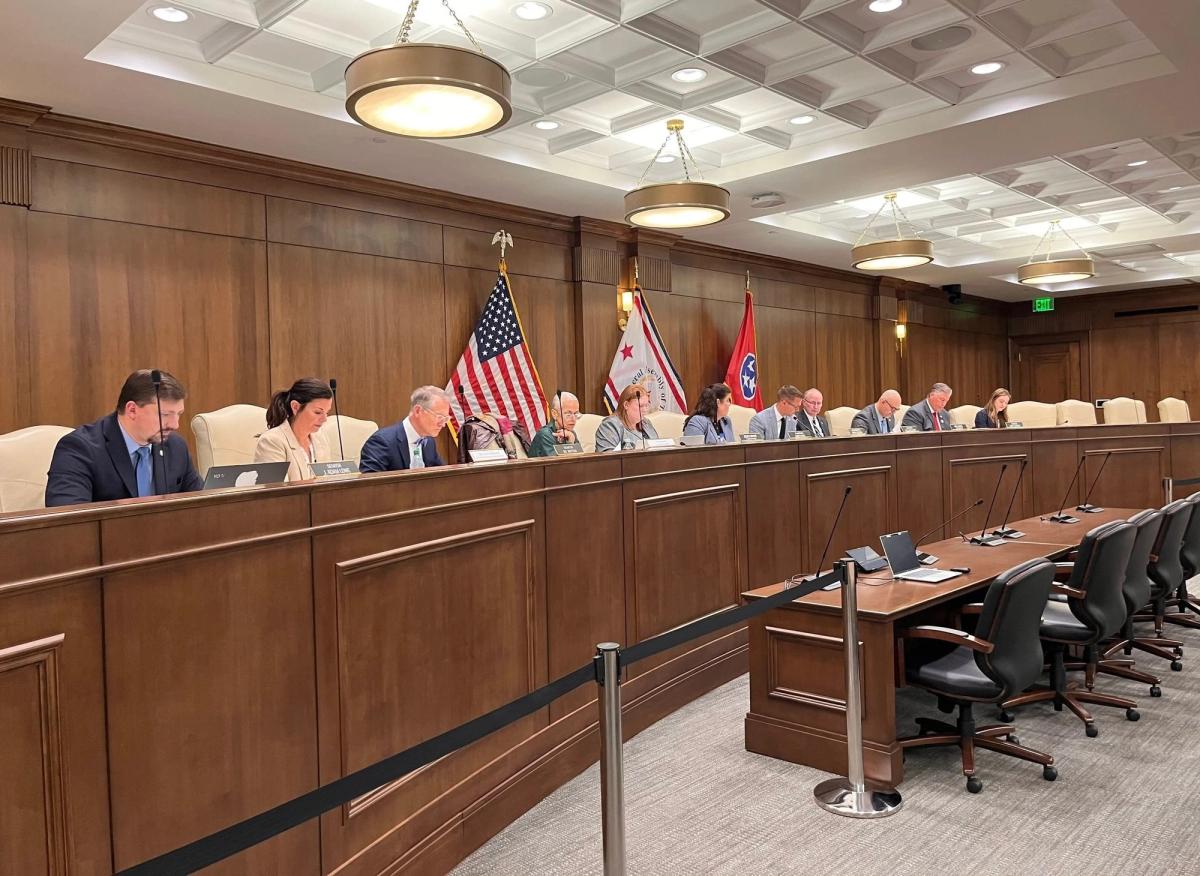

Last year, state lawmakers created the Advisory Committee on Innovations in K-12 Education, in part, to address whether Tennessee students are spending too much time taking state-mandated tests.
The committee, made up of 8 lawmakers, the Education Commissioner, and a representative from the State Board of Education, held multiple meetings through the summer and fall to discuss testing changes and other education reforms, but on Monday, the group approved a list of recommendations that doesn’t include any reductions in state testing requirements.
Polling shows voters support the state’s annual assessment requirements, and in hearings last year, the Department of Education credited the state’s testing system for driving student improvement.
Review of Locally Mandated Tests Recommended
Members of the committee did provide multiple recommendations that could affect the number of locally mandated tests students take. Schools use those benchmarks to track student progress, and they vary widely across districts.
Representative Scott Cepicky, Culleoka, provided two recommendations for local benchmarks, including aligning their timeline to build students up to state tests in the Spring, and requiring school districts to compile a list of local assessments and the reasons for them.
The latter recommendation is one of the few to be included as a bill for the General Assembly to consider this year. Other committee recommendations will likely be considered by lawmakers next year.
Changes to Teacher Evaluations
Another contested issue the committee was tasked with evaluating is whether the state should reduce the frequency of evaluations for some teachers. Under the Tennessee Educator Acceleration Model (TEAM) system, educators are evaluated at least once a year, and each teacher’s overall grade is based on observation, student growth, and student achievement. 
Committee members questioned the potential for bias in the observation process during meetings last year, given that 96 percent of teachers received a grade of “met expectations” or higher on their evaluations.
Rep. Mark Cochran, R-Englewood, recommended addressing the issue by requiring that every third observation be conducted by a principal from a different school, while Representative William Slater, R-Gallatin, recommended requiring lower-performing teachers to participate in more observations.
Senator Adam Lowe, R-Calhoun, also recommended creating a pilot program to encourage teachers to take on more challenging assignments by offering merit pay to high-performing teachers who choose to teach in the lowest-performing areas.
“Clearly from a budget angle, this wasn’t the year for us to kind of pick up that mantle and run with it,” said Lowe. “But I really think we have an opportunity there to take some of our best educators and put them in those low-performing areas under the premise of merit pay and really make it very clear that growth is the goal.
Other Committee Recommendations
The committee additionally spent time last year studying the state’s 180 instruction requirement, teacher licensure, graduation requirements, and changes to career and technical education (CTE).
Some of the recommendations on those areas include:
- Allowing high schools to have additional flexibility to move from an hours, to a days-based model.
- Establishing a pilot program for flexible scheduling with magnet schools.
- Codifying teacher residency program requirements in law.
- Aligning industry certifications with employer needs to ensure that students have employment once obtaining an industry certification.
- Extending dual enrollment opportunities to ninth and tenth graders.
“I think there (are) some really solid things in here that make for good reforms that we can look at to improve education in the state of Tennessee,” said Lowe. “Because we have put a lot of capital and a lot of funding into public education, and now, I think we’re getting to the point where we’ve addressed the big elephants in the room, teacher pay, the things that often get the most vitriol, but a surgical approach to investment now in the state of Tennessee might reap greater returns for our students.”
Algebra II Graduation Requirement
One potentially controversial recommendation came from Representative Cochran, who proposed allowing students on a CTE pathway the ability to use statistics as an alternative to Algebra II for graduation requirements.
Polling from earlier this year found that 67 percent of Tennessee voters oppose removing Algebra II as a graduation requirement. Opponents of removing Algebra II as a graduation requirement have warned that the change could put Tennessee students at a competitive disadvantage when applying to college, as the subject is required by many four-year institutions.