

Nurses Middle College Does More with Less While Fighting Nursing Shortage
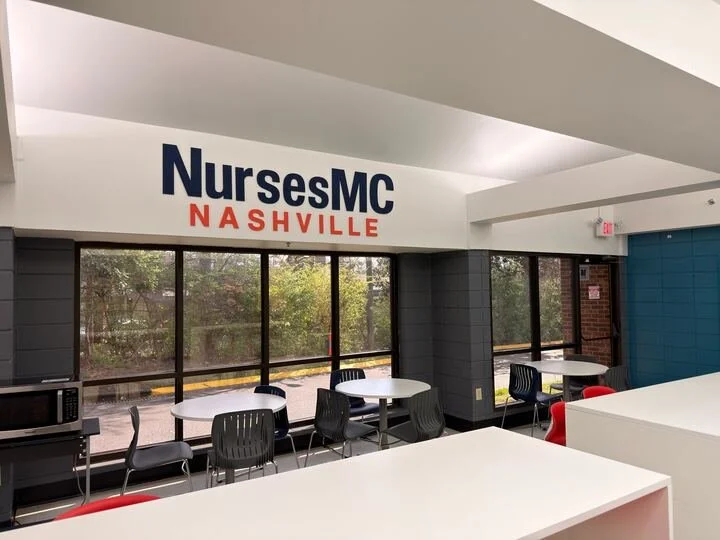
The Nurses Middle College - Nashville cafeteria. (Photo by Jacob Holley)
Dr. Andrea Poynter says she’s been surprised by how her perspective on the Nashville education community has changed over her first school year at the helm of Nurses Middle College - Nashville, and by how tightly-knit it really is.
“(When) you start going to all these networking events and meetings, and it's like, ‘Wait a minute, I see you, I know you,’” Poynter said. “We’re all in the same and similar circle.”
Poynter spent years teaching at Tennessee State University, Columbia State Community College, and Belmont University and realized that many nursing students she taught weren’t coming into the program prepared, even as the United States was already facing a nursing shortage. After being introduced to the leaders of Nurses Middle College, which operates two other public charter schools in other states, she began work to expand it into Nashville and received approval in 2024.
Now, nearly a year into the school’s first year, the executive director of Nurses Middle College – Nashville is deadling with rapid expansion while trying to secure new buildings, resources, and funding.
Outpacing Their Facilities
NMC – Nashville is serving ninth-grade students this year and plans to expand to tenth grade in the 2026-2027 school year, then add a new grade in each of the following two years.
Teachers are currently operating in a “temporary space” that has just eight classrooms for 123 students.
The school’s long-term goals will require a facility of 50,000 to 75,000 square feet, with enough space to accommodate 32 classrooms and labs, simulations, and other medical education needs. Poynter said she would also like to have a gymnasium and auditorium.
“Oftentimes, we have to find industrial sites and try to convert them, which is usually how charter schools have to acquire buildings,” Poynter said. “But then it's the cost that goes into converting these facilities, and that responsibility is solely up for the school to have to manage and navigate.”
Unlike traditional public schools that receive local funding for facilities, charter schools are responsible for sourcing their own locations and, in most states, including Tennessee, must remain nonprofits.
“Next school year, we will be rotating classroom spaces,” Poynter said. “It’s just part of it; you figure out a way to navigate into shifts. So only a few standard classes, like your math, your English, (and) science classes will be stationary, but our other classes will be dynamic, and we'll have to shift placement and positioning.”
Growing Quicker than Funding Streams
While attempting to grow in size and expand its student load, NMC – Nashville has also encountered funding challenges. Poynter said that many of the lenders she has spoken to want to see three to four years of consistent growth before investing in the school. The timelines, unfortunately, do not add up as the school is growing quicker than it can secure funding.
Next year alone, NMC – Nashville expects to accommodate 250 to 275 students while searching for this permanent space.
“It just puts you in a weird space, because I have to prove the results to be able to get the funding,” Poynter said. “But before I get to this three-year data piece, I'll be out of space. I wish there was a quarterly or twice-a-year method by which they can come in and track and assess and to review to be like, ‘Ok, yeah, this is a high-risk investment, but it's worth it because we're investing in students.’”
