
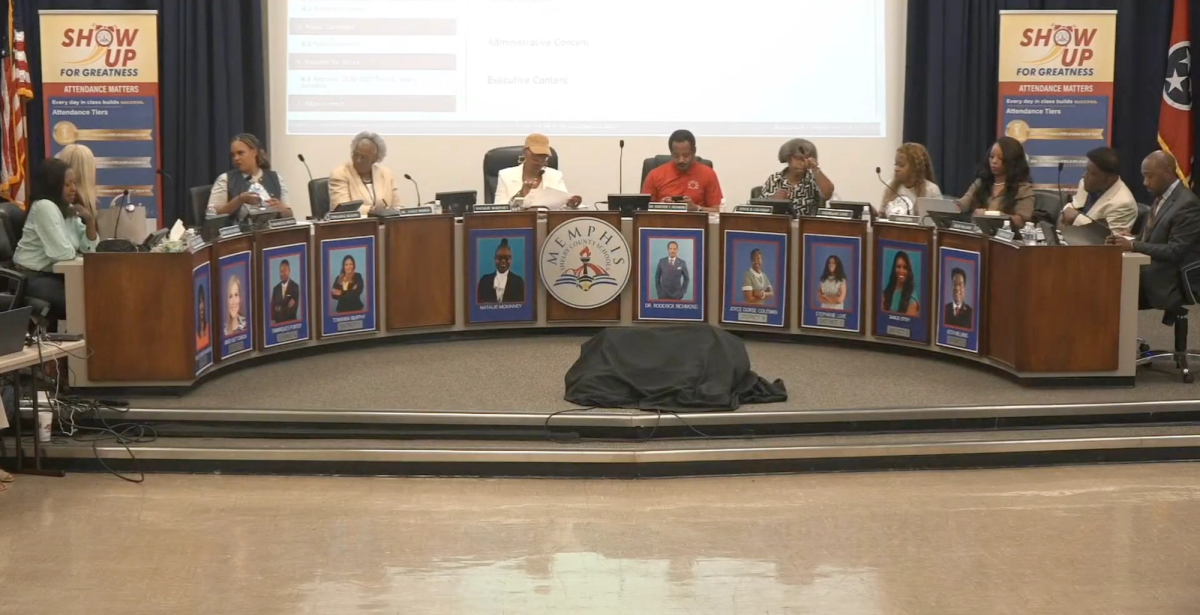

The Memphis-Shelby County School Board rejected six public charter school applications during its meeting on Tuesday, but if you blinked, you might have missed it.
The district voted down applications for Blueprint College and Career Prep, Empowerment Academy, Memphis Elites STEAM Academy, Opportunity Youth Academy, and Urban Dove Team Charter Schools Memphis I and II, on the consent calendar.
That means, instead of engaging in discussion about the proposed schools and their individual merits, the board rolled a single recommendation to deny all four applications into one vote.
Charter schools are free public schools operated by a nonprofit organization under a “charter” with a school district or the state. In Tennessee, most charter applicants apply to their local school districts for an initial vote in April, and all six will have the option to submit amended applications that address any district concerns. Board members will vote on those amended applications this summer.
Blueprint College and Career Prep Model
The six denied applications each offered different education models serving different community needs.
Blueprint College and Career Prep would likely be located in the Cordova area and would focus academically on college readiness and career/workforce development. At capacity, it would serve up to 500 students in grades nine through 12.
Blueprint’s application states that the school’s mission is “to disrupt multigenerational poverty by equipping students in grades 9–12 with rigorous academic instruction, career-aligned skills, and postsecondary readiness experiences that prepare them to graduate on time work ready and succeed in college, workforce, or advanced training pathways.”
Board members denied Blueprint's related application in 2024.
Empowerment Academy Model
The Empowerment Academy – Memphis does not have a set location yet, but it would focus on agriculture and STEM (science, technology, engineering, and math) education while serving up to 150 students in grades K-5 immediately upon opening.
“The Empowerment Academy’s goals coalesce into a comprehensive, equity-driven educational service model that supports the whole child academically, socially, emotionally, and morally through an inclusive, culturally responsive, and community-anchored approach,” part of the application reads.
Applicants with the Empowerment Academy submitted three applications to school districts across the state this year, each proposing a micro charter school serving between 50 and 150 K-5 grade students.
Education advocacy organization Tennesseans for Student Success’s (TSS) Quality Charter Review found that none of the Empowerment Academy applications met state standards. The Tennessee Firefly is a project of and supported by TSS.
Memphis Elites STEAM Academy Model
Memphis Elites STEAM Academy’s academic focus lies in its name. STEAM stands for Science, Technology, Engineering, Arts, and Mathematics. It is an evolution of the STEM model that integrates the arts, such as drama, design, and visual arts, into its curriculum.
Memphis Elites would open at capacity, serving 360 K-8 students at a location in the North Memphis/Frayser area.
The school’s application states that its goals by year five would include ensuring at least 85 percent of its eighth-grade students are ready for high school and enrolled in advanced STEAM programs and achieving 95 percent enrollment capacity.
Opportunity Youth Academy Model
Opportunity Youth Academy (formerly Frayser Leadership Academy) was to be located in the Frayser area and operate at capacity by its third year, serving 300 students in grades 9-12.
OYA would be an Opportunity Public Charter School, a model approved by the state starting in the 2026-2027 school year. The model specializes in middle and high school students, 75 percent of whom would have to be dealing with various challenges, such as juvenile crime, chronic absenteeism, substance abuse, and teen pregnancy. The school had a target of achieving a 67 percent annual stabilization rate by its fourth year.
Urban Dove I and II Model
Urban Dove’s proposed locations would have been in Hickory Hill and the Frayser area. Both schools would also serve as Opportunity Public Charter Schools, serving up to 310 students at capacity by year five. However, Urban Dove differs from OYA in that its schools would have no grade levels and would instead operate in “teams.”
Terri Gaston, school leader for Urban Dove Team Charter School Memphis I, spoke to the board about the school’s mission, her love of working with children each day, and her personal commitment to Urban Dove, having spent more than 20 years serving students in Memphis.
“I'm here tonight to express gratitude for this process and for the opportunity to share the vision behind Urban Dove at its heart,” Gaston said. “Urban Dove exists to help young people who may not always see themselves reflected in traditional success stories, students who are incredibly capable, talented, resilient, and full of potential, but who often need a school that provides the right environment, relationships, and mentorship fully thrive,” Gaston said.
Dianechia Fields, who is the director of operations and fellowship for Memphis Lift, an organization founded to empower underserved Memphis students and their families, also spoke in support of Urban Dove and Opportunity Youth Academy. She emphasized that these proposed schools are specialized for students who have been disconnected from traditional systems.
“By approving these charters, you are approving essential lifelines and ensuring these vulnerable students have a place to succeed,” Fields said. “I urge the board to be intentional and approve both applications who support these students.”