Nashville Board Members Show Bias, Admit “Nitpicking” in Charter School Denials
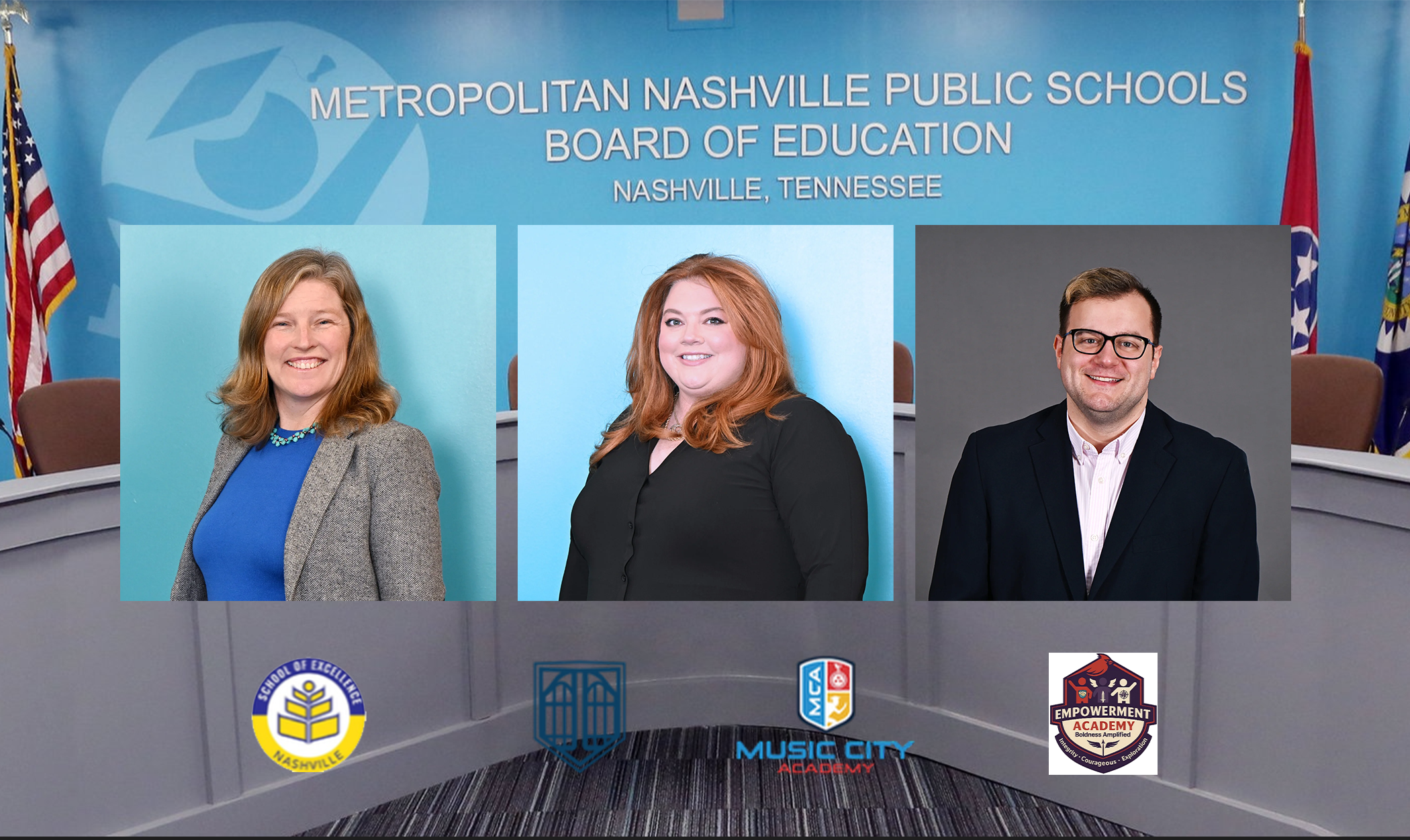
Emily Sandoval Perez told members of the Metro Nashville Schools Board of Education that students like her left Burrus Cox’s Vallor Collegiate eighth-grade math class with the confidence to succeed.
“His compassionate style of teaching made it ridiculously easy for me and my peers to seek him in times (when) we needed that extra push,” said Perez. “Mr. Burrus changed my life and the lives of my peers.”
The high schooler’s comments on Tuesday night were among multiple in support of Cox’s application to open a new public charter middle school in West Nashville known as The Gate School.
The proposed 6-8 grade school would use the Harkness Method, a discussion-based teaching model in which small groups of students sit around an oval table rather than in rows of desks. The concept is more common among elite private schools, but Cox believes the community-centered approach to learning will provide families with a needed school option. His school would additionally use a system in which all adults in the building serve as teachers.
“At The Gate School, three things will be true every day. Every leader will teach, and every great teacher will lead,” Cox said. “I believe deeply in The Gate School and what we’re creating.”
Unanimous Denial
Multiple school board members, including Erin O’Hara Block, expressed interest in the proposed school but ultimately voted unanimously to reject it, along with three other charter applicants.
Charter schools are free public schools operated by a nonprofit organization under a “charter” with a school district or the state. In Tennessee, most charter applicants apply to their local school districts for an initial vote in April.
MNPS board members haven’t approved a new charter school since 2021, and that string of denials has led to complaints that district leaders are biased against charters. Tuesday’s vote will only add to those complaints.
O’Hara Block told the public that because district-run schools aren’t at capacity, MNPS and charter schools are essentially competing for students and funding without a shared plan for the future.
“There are only so many schools in Nashville and only so many seats, and honestly, I’m not sure where we’re headed,” O’Hara Block said. “We don’t have a shared plan for growth, charter growth in Nashville … I’m open for conversation, but until this board, the charter community, the (charter) commission, can answer all these questions together, it’s really hard for me to want to say yes to anything new, even if I might think there are some good elements.”
“Nitpicking” Against Music City Academy
One board member even questioned the way another charter applicant was evaluated.
Former Tennessee Titans wide receiver Kevin Dyson applied to open the Music City Academy for high school students in North and West Nashville. The charter school would provide students with a team-centered, career-connected learning model that connects students to sports-related careers, including sports medicine, emergency services, and audio/visual production.
“The discipline developed through training becomes the same discipline needed to earn credentials, create opportunities, and change life trajectories,” Dyson said. “This isn’t athletics sitting beside academics. This is using athletics, team, and movement as the bridge that leads students to the real game, academic success, career readiness, and real-life opportunity.”
The district’s charter review team found that the Music City Academy’s application met state standards in one category and partially met them in the other two. Schools must meet state standards in the Academic Plan and Capacity, Operational Plan and Capacity, and Financial Plan and Capacity to be deemed ready for approval.
Among the district’s critiques was the claim that the application cited an incorrect number of state championships won by MNPS teams.
Board Member Zach Young felt that criticism was unnecessary.
“I think that [critique] speaks to the quality of the application that that’s what we’re nitpicking about, and it really frustrates me because I know that that charter review committee does really hard work and I am not knocking their work,” Young said. “I don’t think bickering over a number of championships is the way to do it, and I think we can do better than that.”
Funding Concerns
Multiple board members raised monetary concerns with the applications, including Rachael Anne Elrod, who misled the public about how charter schools are funded by suggesting they receive “prioritized funding.” She said Music City Academy didn’t prove its school model was worth “prioritized funding.”
“It needs to be (an) overwhelming amount of evidence to us that this is available and should be prioritized funding, as it is prioritized funding over our current public schools,” said Elrod. “It needs to be; they more than meet (state requirements), they excel, and that this is an absolute for us.”
In Tennessee, state education dollars follow the student to whatever school they attend, and charter schools receive the same amount as traditional public schools. They additionally do not receive the same local dollars for facilities that MNPS schools receive.
Other Charter Applicants Denied
Board members also voted down applications to open the Empowerment Academy – Middle Tennessee and the Nashville School of Excellence.
The 6-12 grade Nashville School of Excellence would be an expansion of the existing Memphis School of Excellence STEM (science, technology, engineering, and math) model, serving students in the South Nashville and Nolensville Road Area
Leaders of the proposed school would have targeted immigrant families in the area for enrollment.
An immigrant father of four from Uzbekistan was among those speaking in support of Nashville School of Excellence before Tuesday’s vote. He told board members that school leaders have built the trust of the Uzbek community, and 370 families have expressed interest in sending their children there.
“Like many families, we came here with a clear goal to give the children access to a high-quality education and better future. For us, education is the most important foundation for success, ability, and long-term contribution,” said the father. “They take the time to listen and communicate clearly and build the trust with the families from diverse backgrounds. This consistent engagement is especially valuable for ensuring the strong school-family partnership.”
Applicants with the Empowerment Academy submitted three applications to school districts this year, each proposing a micro charter school serving between 50 and 150 K-5 grade students. Education advocacy organization Tennesseans for Student Success’s (TSS) Quality Charter Review found that none of the Empowerment Academy applications met state standards in Academics, Operations, or Financial Plan and Capacity. The Tennessee Firefly is a project of and supported by TSS.
All four charter applicants will have the option to submit an amended application that addresses the district review team’s concerns. Board members will vote on those amended applications this summer.