

Report Finds Funding Tweak Could Lead Students to Jobs

Students throwing their caps at a graduation ceremony. (Stock Image)
A new report from the education organization Tennessee SCORE argues the state isn’t doing enough to ensure students have high-paying jobs when they graduate.
SCORE’s latest memo, calls for overhauling a state funding component known as the “high-need premium” to better align the dollars Tennessee provides institutions of higher learning with programs that prepare students for high-wage, in-demand careers.
What Is The “High-Need Premium?”
The “high-need premium,” which is also known as the “workforce investment premium,” was designed to incentivize education institutions to prepare graduates with credentials that meet Tennessee’s economic needs. SCORE says that, by replacing the premium with what it calls a “tiered impact credential bonus,” the state can better ensure long-term success for students and the workforce.
“Its current definition relies on broad program categories rather than measurable wage and labor-market outcomes,” SCORE’s new memo reads. “As a result, it does not consistently reward credentials that lead to high-wage, in-demand careers.”
Why Discuss This Now?
The “high-need premium” is a component of Tennessee’s outcomes-based funding formula, which is currently undergoing a five-year review. During this process, policymakers have an opportunity to revise parts of the system.
SCORE argues that updating the high-need premium now would help ensure that the funding formula more accurately reflects workforce priorities and economic results.
The Outcomes-Based Funding Formula
Tennessee implements an outcomes-based funding formula that earmarks state money to Tennessee’s public colleges and universities based on how well they perform. In the past, schools received funding mostly based on the number of students they enrolled. Since the passage of the Complete College Tennessee Act of 2010, most funding now depends on how well institutions help students succeed, such as progressing through college, graduating, and entering the workforce.
The funding formula has three main components:
Component Share of Formula What it Measures
Student outcomes (performance) 78 percent Student progress, degrees earned, job placement, etc.
Fixed costs 17 percent Basic operating costs like facilities
Quality assurance 5 percent Measures of academic quality and student support
Why The High-Need Premium Is Inadequate
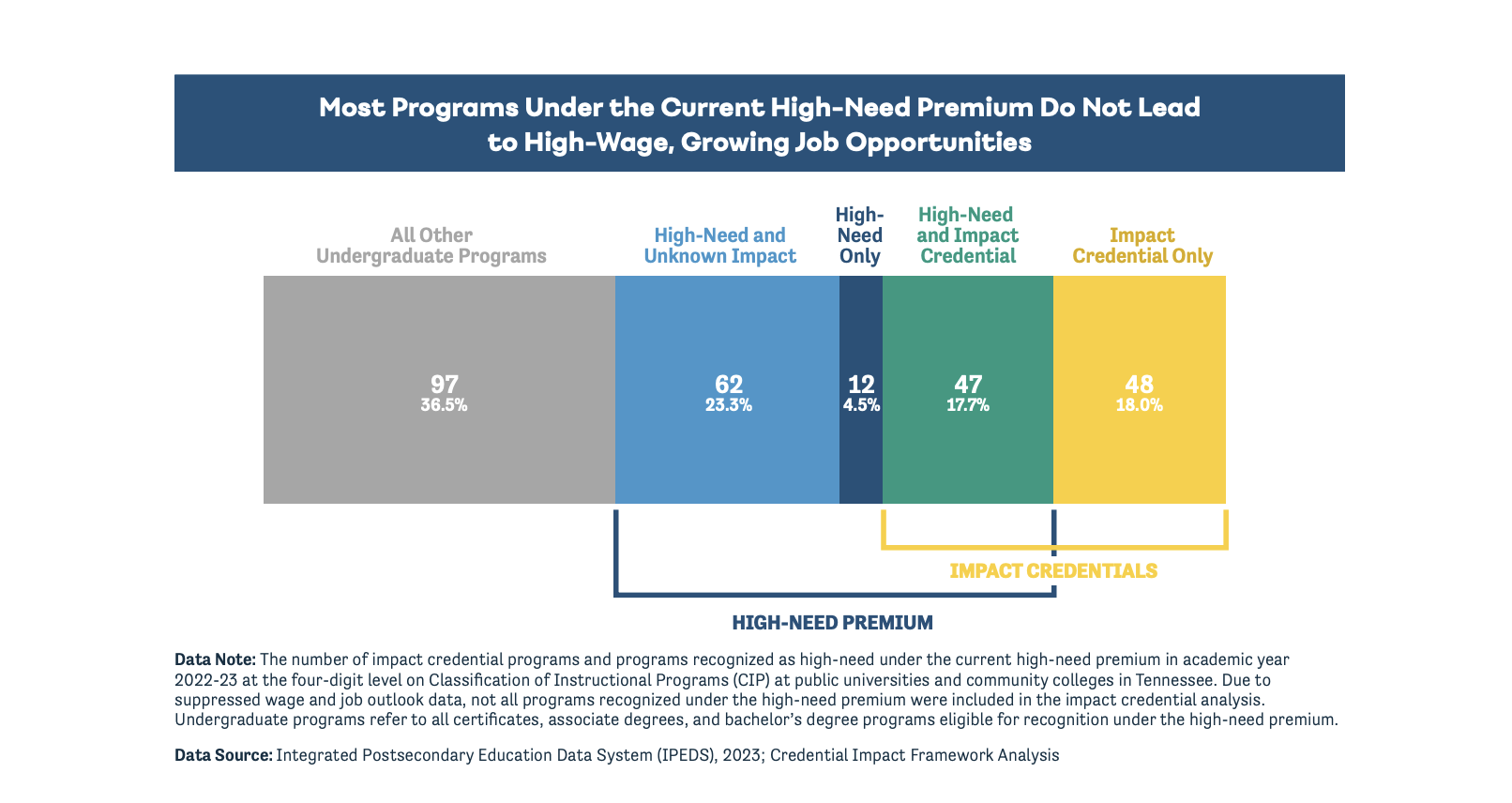
The high-need premium is meant to encourage colleges to produce graduates in the fields the workforce needs the most. However, SCORE says that the current system does not actually measure whether those programs lead to high-paying or in-demand jobs; instead, it identifies programs using broad academic categories rather than real-world data, such as wages or job demand.
The organization’s proposed solution is to replace the high-need premium with a new system: the tiered impact credential bonus. The new system would use labor-market data to determine which credentials deserve extra funding, and programs would receive different bonus levels depending on their workforce impact.
How The New “Impact Credential” System Would Work
Credentials would be ranked in tiers based on measurable economic results, with higher-impact programs receiving larger funding bonuses under the outcomes-based funding formula. Some examples of criteria could include the median wages after graduation, job demand and employment growth, and labor-market alignment with state workforce needs.
The Tennessee Higher Education Commission is holding a statutory meeting next week about the outcomes-based funding formula.
