
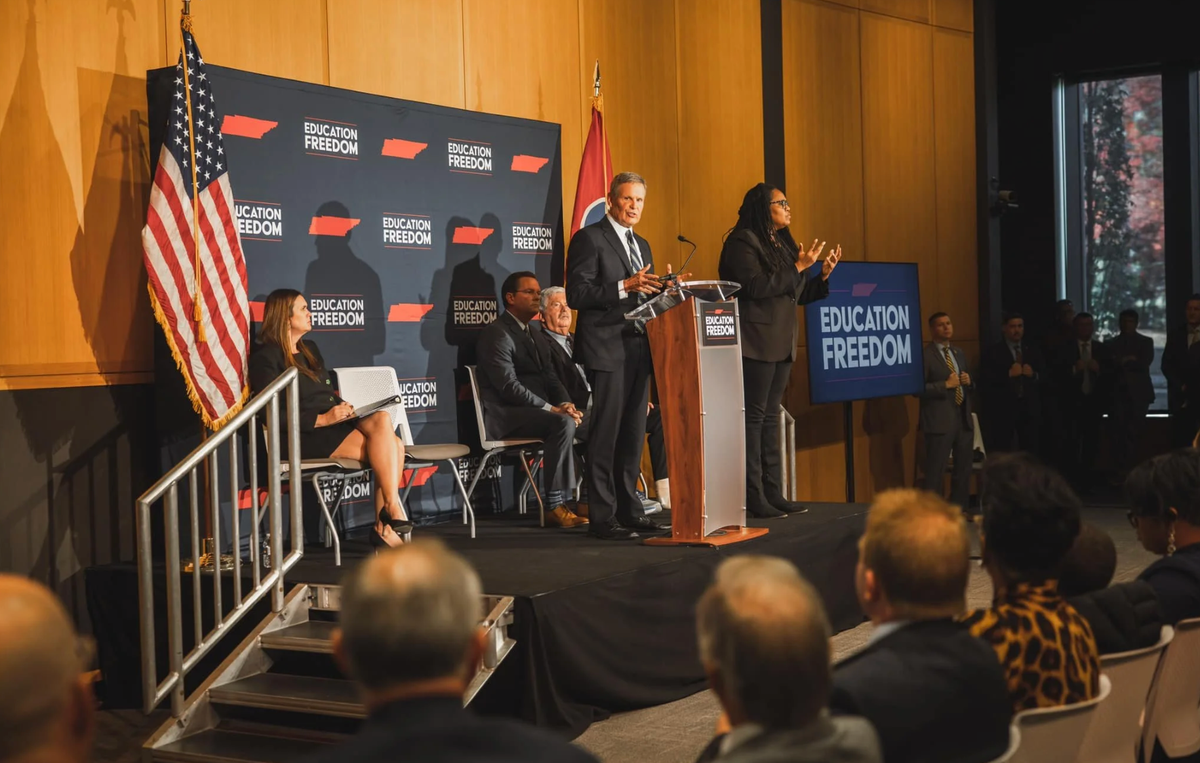

A bill that would expand the number of Education Freedom Scholarships is now headed to Governor Bill Lee’s desk with a smaller number than he initially proposed.
The Senate agreed to follow the House’s proposal to expand the number of scholarships available by 15,000, to a total of 35,000. Governor Lee initially proposed expanding the program that allows families to use taxpayer dollars for private school expenses to 40,000 scholarships.
Despite the smaller expansion, Governor Lee expressed gratitude on social media following the vote.
“Long before I became Governor, I believed that every child should have the opportunity to receive a quality education that best fits their needs, regardless of zip code or income,” wrote Lee. “Today, I’m grateful that the TN General Assembly voted overwhelmingly to expand the Education Freedom Scholarship Program & deliver school choice for thousands more families.”
Supporters Cite Demand
The governor and bill supporters have argued that the expansion was needed following two consecutive years in which program applications exceeded the number of available scholarships.
During the Senate floor session, a handful of lawmakers expressed support for the bill, including Senator Kerry Roberts, R-Springfield, who highlighted his belief that there’s a need for additional educational options for children whose needs cannot be met by traditional public schools.
“A child is more than a number,” Roberts said. “A child is more than a test score. A child is more than a data point and a funding formula. I also want to point out that a successful school doesn't guarantee a successful child.”
Bipartisan Opposition
The 18-14 vote in favor of the program’s expansion included eight Republicans, who joined all six Democrats in opposing the bill.
That included Senator Joey Hensley, R-Hohenwald, who has stated various times throughout this session that he supports the program but is concerned about the fiscal impact of expanding it rapidly, instead of sticking to its original parameters. The 15,000 expansion would cost the state roughly $113 million.
“I support parental choice,” Hensley said. “I think we should stick to the (5,000 scholarship) increase every year so that our budget doesn't wind up like Arizona and some of these other states.”
Democrats have opposed the program, frequently referred to as vouchers, from the beginning, arguing that it will subsidize wealthy families sending their children to private schools.
Senator Raumesh Akbari, D-Memphis, made that case on Thursday, saying there’s no evidence that the program is creating better education opportunities for students.
“We already have a program in place that allows 20,000 (scholarships),” Akbari said. “With the law as it exists, it will bump up to 25,000. Let's get some data. Let's see if this works. Let's see what our budget looks like next year, and the following year, and the following year, before we talk about doubling a program. I don't know a single program in this state that we have passed where, within one year, we have doubled it with very limited data and even less transparency.”
Other House Bill Provisions
House Bill 2532 also extends the “hold harmless” provision from the original 2025 Education Freedom Scholarship legislation, which ensures school districts continue to receive the same amount of state dollars even if students leave, but it will be limited to those who leave specifically because they’re utilizing the scholarship program starting in the 2028-2029 school year.
The bill also requires the Department of Education to collect and report whether scholarship recipients came from a public school.
Supportive Reaction
Following the vote, TennesseeCAN, an advocacy group promoting K-12 student success in the state, released a statement voicing its approval of the bill’s passage.
“TennesseeCAN applauds the legislature for expanding the number of education freedom scholarships available to Tennessee students,” TennesseeCAN Executive Director Chelsea Crawford said. “Earlier this year, more than 53,000 students applied for only 20,000 scholarships. Expanding the number of scholarships to 35,000 spots will help meet the unique educational needs of students who desire more options.”
The group released a list of policy goals on Jan. 1, in which its first course of action was to help expand the Education Freedom Scholarship program to meet high demand.