Jerri Green Wants to Strengthen Special Education, End “Welfare for the Wealthy”
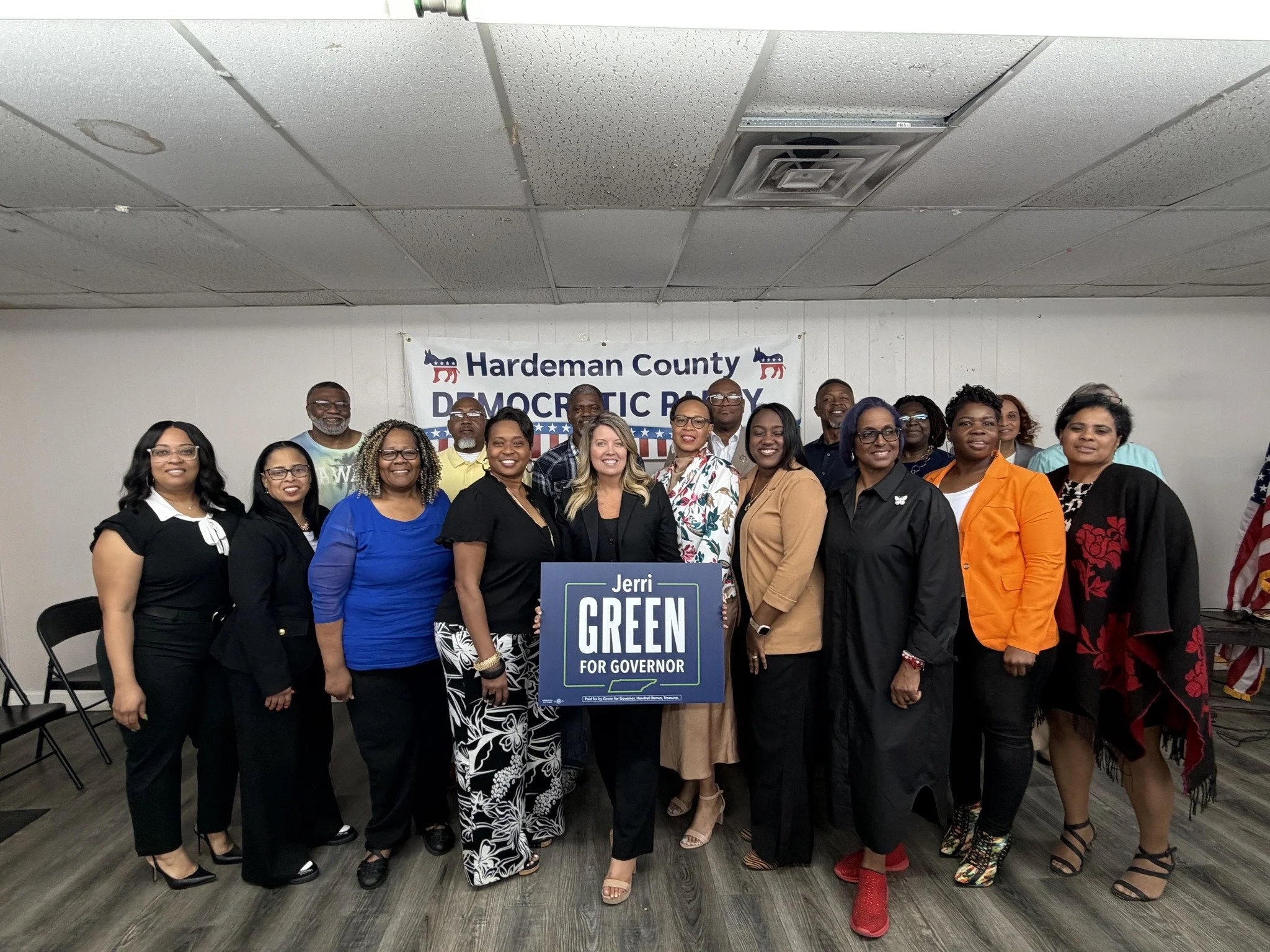
Jerri Green (center) with supporters in West Tennessee (Photo by Green)
Jerri Green says she has a personal reason to include special education reforms in her platform.
The Memphis City Councilwoman and Democratic candidate for governor says her youngest child is Autistic and depends on special programs to provide a pathway for education.
“He has a lot of social issues. He’s in a public school inside a special class that is designed for kids like him who can’t handle a loud music class or who think their uniform is itchy and that can set them off,” said Green in an interview with the Tennessee Firefly’s On the Fly podcast. “I know that without those programs, he wouldn’t be in school.”
Green says her son’s class is only possible through the protections offered by the U.S. Department of Education, and she believes his education will be put in jeopardy by President Trump’s plans to dissolve the department and cede more education authority to states.
Green is proposing incentives for teachers to encourage more to enter special education, and a promise to continue supporting children with special needs if elected governor.
From Memphis Native to City Council
Green was born and raised in Memphis and is currently raising three school-aged children with her husband.
She worked as a public defender in Washington, D.C. before returning to Memphis to serve a variety of leadership and legal roles, including most recently serving as the Deputy Chief of Staff for Shelby County’s Mayor and the county’s Interim Chief Public Defender.
Voters elected her to the Memphis City Council District 2 seat in 2023, and she’s the only candidate in August’s Democratic gubernatorial primary to have held public office before.
Ending Private School Choice
In addition to special education, Green has made eliminating Tennessee’s Education Freedom Scholarship and Education Savings Account programs, which are frequently called school vouchers, a key priority in her campaign. Both allow families to use tax dollars to send their children to private school
“I don’t believe in welfare for the wealthy. I’m sure it’s a very popular program because I too would like a $7,000 coupon to my daughter’s school, but I don’t expect anyone else to pay for that.”
Green says eliminating the programs shouldn’t create issues, as a Tennessee Comptroller report found many ESA participants were already enrolled in private school before receiving program benefits. She says if elected governor, she’d push to move the hundreds of millions Tennessee is spending on both programs to support public schools.
Working with Republicans
Ending either program would require working with Republicans who approved them, as the party currently has a supermajority, and even a strong Democrat showing in November is not expected to change that.
Green acknowledges that she would have to work with Republican leaders in both chambers if elected and says she has experience doing so.
“I don’t think there’s any issue that is off bounds. In my hometown, I have worked on issues as controversial as abortion and guns with Republicans and found consensus,” Green said. “I’m sure people think about jobs, or infrastructure, roads, those sorts of places, but I do think the issue of education is one in particular that we do have a lot of common ground on.”
Green points to the recent vote to expand the Education Freedom Scholarship, which included 8 Republicans in the Senate who opposed the plan and 10 in the House, as one area where there could be common ground for a Democrat leader to work with Republicans.
Charter Schools and Open Enrollment
This week, Green’s home school district in Memphis denied every proposed public charter school, while board members elsewhere in West Tennessee approved four. In recent years, Democrats in Tennessee have not always been supportive of public charter schools.
Green says she sees value in charter schools but doesn’t necessarily believe the time is right to increase their number.
“I understand that public charter schools are needed in some places,” Green said. “But I do think it is secondary to fully funding our (traditional) public schools. That’s really where we need to start, where we need to focus … We’ve got to make sure we build up those spaces and places first before we turn to something like public charter schools.”
Green is more supportive of expanding options for parents to enroll their children in public schools outside of their zoned school or district, frequently called open enrollment.
Legislation that would reduce open enrollment barriers failed in a House subcommittee this month and is expected to return next year.
“If you have a kid that’s really into the performing arts, or playing the violin, and this is the best musical school, public school in the city, yes, we should be able to have some way for parents to take advantage of that,” Green said.
School Accountability
Lawmakers studied reducing accountability for educators last year, including proposals to eliminate the annual evaluation requirement for some teachers. Members of the General Assembly decided not to advance legislation to do so this year, but it remains a possibility in 2027.
Green says she doesn’t support increasing the frequency of teacher evaluations, but sees the existing system as needed, especially for evaluating how teachers implement new ideas in education.
“So, some of the evaluation process needs to be, are you incorporating this, are you taking back the new things that we are bringing in?” Green said. “I don’t want it to be burdensome on teachers or on administrative staff. They’ve got a lot on their plates.”
Memphis Intervention
Like her fellow Democrats in the General Assembly, Green does not support recent efforts to intervene in school districts like Memphis-Shelby County Schools. She says the district’s challenges could be better solved by investing more money.
“Local government governs best,” Green said. “Instead of having this, sort of control, that they like to have in Memphis over certain issues, I would rather look to a model like Mississippi and see how they’ve been investing in their children, in their teachers, in their schools, and turning around literacy rates and turning around that population. That’s what we need.”
Challenging Political Environment
Green has a significant lead in campaign contributions over her opponents in next August’s Democratic primary, but polls show any Democrat will be a heavy underdog against the Republican primary winner in November.
Last year’s poll from the Beacon Center found both U.S. Senator Marsha Blackburn and Congressman John Rose leading a generic Democratic candidate by 19 points.